Sludge thickening is the process of removing water from wastewater sludge to increase its solids concentration while maintaining pumpability. By reducing the volume of dilute sludge early in the treatment process, facilities can improve digestion performance, reduce energy demand, and better manage downstream solids handling.

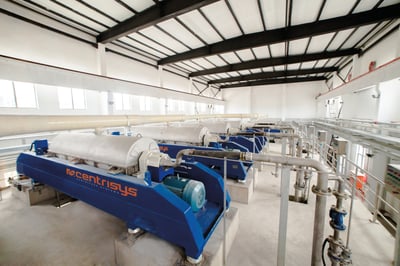
equipment-sludge-thickener-centrifuge-THK350-1

What Is Sludge Thickening?

Sludge thickening is the process of removing water from wastewater biosolids to increase the concentration of solids. When treatment facilities deal with the challenge of managing large volumes of dilute sludge, sometimes containing as little as 0.4% to 2% solids, thickening becomes a critical first step that impacts everything downstream, from digester performance to disposal costs.

The goal of sludge thickening is to concentrate the solids before further treatment, storage, or disposal. By reducing sludge volume early in the process, facilities can dramatically lower handling costs, improve digester efficiency, and reduce the burden on dewatering equipment.

Sludge thickening commonly produces sludge solids concentrations in the 3% to 7% range, resulting in an 80% volume reduction. For a facility processing millions of gallons daily, these volume reductions translate directly into operational savings.

Sludge Thickening vs. Dewatering: What’s the Difference?

Sludge thickening and sludge dewatering serve two very different purposes in a wastewater treatment plant. Both processes remove water from sludge, but they do so to achieve different goals and at different stages of the solids handling process.

Understanding the difference between sludge thickening and sludge dewatering is critical when evaluating solids handling equipment. Each process has a different objective, operates at a different point in the treatment train, and requires equipment designed for that specific duty. 

Sludge Thickening

Sludge thickening is designed to increase solids concentration while keeping the material pumpable. The result is a concentrated slurry, not a dry cake.

sludge-thickener-centrifuge-diagram-1-croppedTypical outcomes:

  • Increases solids concentration from approximately 0.4–2% to 3–7% total solids (TS)

  • Reduces sludge volume by up to 80%

  • Maintains a fluid, pumpable consistency

  • Typically installed before anaerobic digestion

The primary goal of thickening is to reduce hydraulic volume entering digesters, storage tanks, or downstream processes. By concentrating solids early, facilities reduce tank size requirements, heating loads, and overall energy consumption in digestion.

Sludge thickening is often described as a liquid–liquid separation process, because both the clarified centrate and the thickened sludge remain fluid.

Sludge Dewatering

Sludge dewatering, by contrast, is designed to remove as much water as possible to produce a stackable, transportable cake.

Typical outcomes:

  • Increases solids concentration to 15–35% TS (depending on sludge type and equipment)

  • Produces a solid cake suitable for hauling, landfill, or drying

  • Typically installed after digestion

Dewatering focuses on removing free liquid from sludge to produce a drier solids cake while separating clarified centrate. The dewatered cake then proceeds to a low-temperature belt dryer, which serves as the next stage of water removal before final storage, disposal, or beneficial reuse.

Key Differences at a Glance

Sludge Thickening Sludge Dewatering
Occurs before digestion Occurs after digestion
Produces pumpable slurry (3 - 7% TS) Produces stackable cake (15 - 35% TS)
Reduces digester volume Reduces hauling and disposal costs
Liquid-liquid separation Liquid-solid separation

Where Does Sludge Thickening Fit into the Wastewater Solids Process?

Sludge thickening typically occurs before anaerobic digestion in the wastewater solids handling process. Rather than sending dilute sludge directly to digesters, facilities first concentrate it through thickening. Increasing solids concentration to approximately 3–7% total solids (TS) reduces the hydraulic volume entering digestion and improves process efficiency.

What Are the Benefits of Sludge Thickening?

Without thickening, dilute sludge must be pumped, heated, mixed, and processed in large volumes. This increases hydraulic load on digesters, drives up energy consumption, and requires larger tankage to achieve adequate solids retention time.

By increasing solids concentration, sludge thickening helps to:

  • Reduce the hydraulic volume entering anaerobic digesters

  • Improve solids retention time within digestion

  • Lower heating and mixing requirements per unit of solids

  • Stabilize feed concentration for downstream processes

Sludge thickening also helps balance and condition sludge prior to dewatering, creating a more consistent and manageable solids stream for the next stage of treatment.

The operational efficiencies gained through sludge thickening—lower pumping volumes, reduced heating loads, and more stable downstream performance—contribute directly to lower energy costs, reduced infrastructure demands, and improved long-term cost control.

Applications Where Sludge Thickening Delivers the Most Impact

Beijing THK600 v1 clean logoWhile sludge thickening is used across many wastewater treatment environments, its operational impact is especially significant in facilities where sludge volume, digestion capacity, and hauling costs are major considerations.

  • Municipal Wastewater Treatment Plants: Municipal facilities often use thickening to concentrate primary sludge and waste-activated sludge (WAS) before anaerobic digestion. Because digesters are capital-intensive assets, reducing the volume entering digestion can improve capacity utilization and delay costly expansion projects.

  • Food and Beverage Processing: Food processors, breweries, wineries, and dairy facilities generate high-strength organic waste streams. Thickening can reduce hauling volume and stabilize solids prior to further treatment or disposal.

  • Industrial Wastewater Facilities: Industrial operations—including pulp and paper, chemical manufacturing, and specialty processing—often rely on thickening to manage biological solids, improve downstream handling, and reduce disposal volume.

  • Facilities with Limited Footprint: Plants constrained by space may benefit significantly from technologies that concentrate sludge without requiring large settling tanks or flotation basins.

Sludge Thickening Technologies 

There are many sludge thickening technologies on the market; each relies on a different separation process to concentrate sludge from a dilute form to a higher total solids percentage.

  • Gravity Thickeners: Gravity thickeners use settling tanks where solids naturally settle to the bottom over time while clarified liquid overflows from the top. They are commonly used for primary sludge and require significant tank volume to achieve adequate separation.

  • Gravity Belt Thickeners: Gravity belt thickeners apply polymer-conditioned sludge onto a moving porous belt, allowing water to drain by gravity while solids are conveyed forward. This technology is widely used for waste-activated sludge (WAS) and typically depends on polymer to achieve target solids concentration.

  • Rotary Drum Thickeners: Rotary drum thickeners introduce polymer-conditioned sludge into a rotating cylindrical screen. Water drains through the screen while thickened solids are retained and discharged at the end of the drum.

  • Dissolved Air Flotation (DAF): DAF systems dissolve air into the sludge stream under pressure and release it to form microbubbles that attach to solids, causing them to float. The floated solids are then skimmed from the surface for collection and further processing.

  • Modified Decanter Centrifuges: Modified decanter centrifuges adapt dewatering centrifuge designs for thickening applications. Because they are originally engineered for dry cake production rather than liquid–liquid separation, polymer is often required to maintain capture and achieve target thickened solids concentration.

Many of these sludge thickening technologies rely on polymer addition to achieve target solids concentration and capture rates. While effective, ongoing polymer consumption can represent a significant operational cost and introduce variability in performance.

When evaluating sludge thickening options, facilities should consider not only solids concentration and footprint, but also long-term chemical dependency and operating expense. 

Key Considerations When Evaluating Sludge Thickening Solutions

When evaluating sludge thickening equipment, facilities should consider more than just the target solids concentration. Key evaluation factors include
  • Sludge characteristics (including SVI and seasonal variability)

  • Desired thickened solids concentration

  • Required capture efficiency

  • Polymer dependency tolerance

  • Energy consumption profile

  • Available footprint

  • Upstream and downstream integration

  • Long-term operating and maintenance costs

Facilities that understand where sludge thickening fits in their solids process are better positioned to select technologies based on lifecycle performance, not just upfront cost.

Purpose-Built vs. Modified Decanter Centrifuge Designs  for Sludge Thickening 

For many years, facilities have commonly adapted decanter centrifuges designed for sludge dewatering to perform sludge thickening. However, there is a fundamental engineering difference between centrifuges designed specifically for thickening and those repurposed from dewatering applications.

While both use centrifugal force, their internal geometry, solids handling approach, and separation objectives are not the same — and those differences directly influence performance and polymer demand.

The Limitations of Modified Dewatering Centrifuges

A decanter centrifuge that has been modified for sludge thickening typically involves installing a hydraulic baffle disc that creates a seal, separating the pool of thickened sludge from the main liquid pool.

This modification creates an inherent inefficiency. Standard dewatering centrifuges have a conical (cone-shaped) section at the solids discharge end. When used for thickening, this entire section becomes completely filled with solids. This packed area prevents water from releasing back into the centrifuge for separation, rendering this portion of the machine useless for clarification.

The result is wasted internal volume and reduced separation efficiency. To compensate, facilities using modified centrifuges almost always need to add polymer chemicals to help particles clump together and settle more effectively within the limited clarification area.

Purpose-Built Sludge Thickening with the THK Series

A different approach is to design a centrifuge specifically for thickening duty.

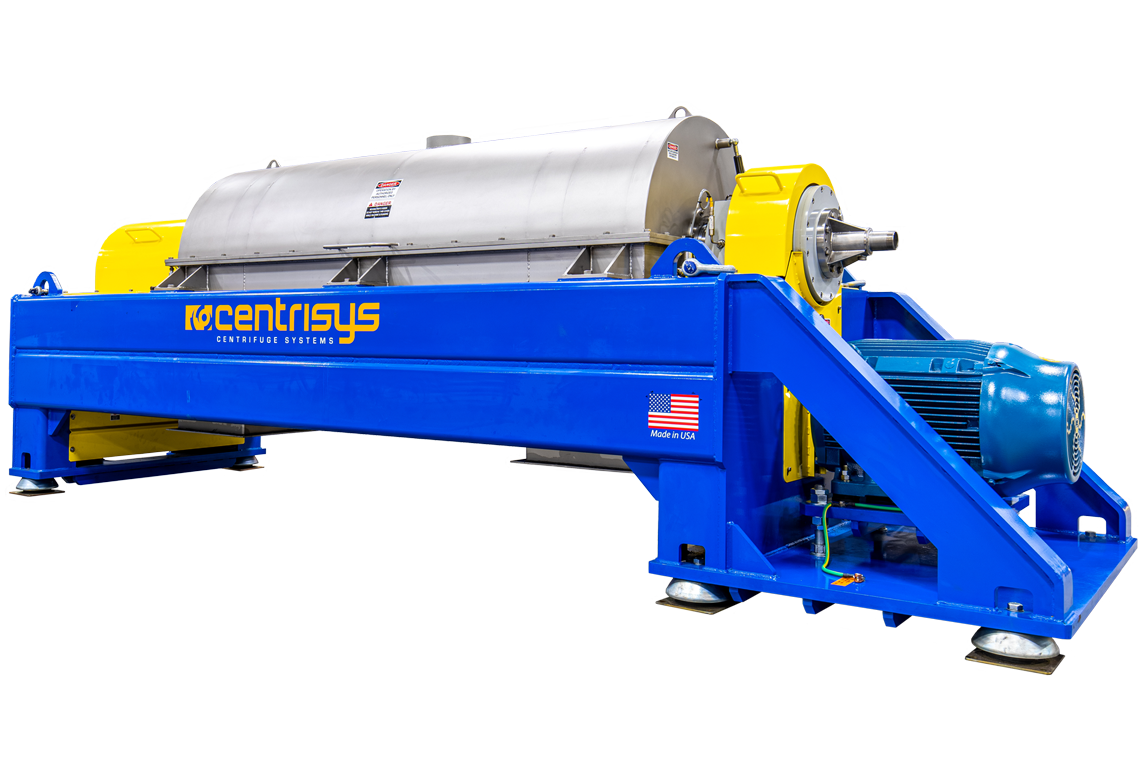
The Centrisys/CNP THK Series centrifuge is a purpose-built sludge thickening system that uses high-speed rotation to separate water from solids. Unlike modified dewatering centrifuges adapted for thickening, the THK was engineered from the ground up specifically for this application.

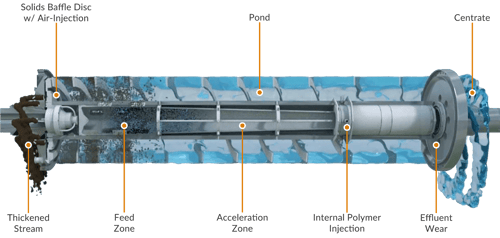
It features a fully cylindrical bowl design with no conical section. By eliminating the cone entirely, the machine utilizes its full internal length for clarification, creating the largest possible G-volume (the total working volume where G-forces separate solids from water).

How Does the THK Series Sludge Thickener Work? 

The separation process operates on the principle of centrifugal force. Sludge enters the feed chamber, where it's rapidly accelerated to high rotational speeds. The immense G-forces press the heavier solids against the outer wall of the centrifuge bowl while the lighter liquid (centrate) forms a layer closer to the center.

An internal scroll conveyor rotates at a slightly different speed than the bowl, continuously moving the separated solids toward the discharge point. Meanwhile, the clarified centrate flows over weirs and exits from a separate discharge port at the opposite end of the machine.

The Hydro-Pneumatic Innovation

Instead of mechanically forcing solids out as a paste, the THK uses a simple principle of physics. Air is injected directly into the collected solids near the discharge point, lowering the specific gravity to between 0.90 and 0.95. Because water has a specific gravity of 1.0, the air-infused solids become lighter than the surrounding water.

The hydraulic pressure of the water pool is then strong enough to continuously push the buoyant solids out of the discharge port. Operators can precisely control the final product by adjusting the airflow. More air produces a thinner cake (around 3% solids), while less air produces a thicker consistency. 

Benefits of the THK Series Sludge Thickener

Because the THK was engineered specifically for sludge thickening, its design influences performance in several measurable ways:

  • Purpose-built cylindrical design maximizing usable clarification volume

  • Polymer-free operation under many normal conditions (polymer optional when needed)

  • Approximately 50% lower power demand compared to dewatering centrifuges used in thickening mode

  • Compact footprint relative to many gravity- or flotation-based systems

  • Enclosed operation supporting improved housekeeping and odor control

  • Real-time control of discharge solids concentration

The THK Series offers a sludge thickening alternative to modified dewatering centrifuges for facilities seeking to reduce polymer dependency, improve energy efficiency, and maximize effective clarification volume.

Specifications

Feature Modified Dewatering Centrifuge THK Thickening
Core Design Conical section adapted for thickening Purpose-built cylindrical design
Clarification Area Limited—conical section filled with solids Maximized—full length used for separation
Solids Discharge Mechanical extrusion produces paste Hydro-pneumatic system uses air injection
Polymer Requirement Almost always needed Not required under normal conditions (150 SVI)
Power Consumption Standard for dewatering centrifuge 50% less than modified dewatering units
Feature Modified Dewatering Centrifuge
Core Design Conical section adapted for thickening
Clarification Area Limited—conical section filled with solids
Solids Discharge Mechanical extrusion produces paste
Polymer Requirement Almost always needed
Power Consumption Standard for dewatering centrifuge
Feature THK Thickening
Core Design Purpose-built cylindrical design
Clarification Area Maximized—full length used for separation
Solids Discharge Hydro-pneumatic system uses air injection
Polymer Requirement Not required under normal conditions (150 SVI)
Power Consumption 50% less than modified dewatering units
Feature
Core Design
Clarification Area
Solids Discharge
Polymer Requirement
Power Consumption
Feature
Core Design
Clarification Area
Solids Discharge
Polymer Requirement
Power Consumption
Feature Modified Dewatering Centrifuge
Core Design Conical section adapted for thickening
Clarification Area Limited—conical section filled with solids
Solids Discharge Mechanical extrusion produces paste
Polymer Requirement Almost always needed
Power Consumption Standard for dewatering centrifuge
Feature THK Thickening
Core Design Purpose-built cylindrical design
Clarification Area Maximized—full length used for separation
Solids Discharge Hydro-pneumatic system uses air injection
Polymer Requirement Not required under normal conditions (150 SVI)
Power Consumption 50% less than modified dewatering units
Feature
Core Design
Clarification Area
Solids Discharge
Polymer Requirement
Power Consumption
Feature
Core Design
Clarification Area
Solids Discharge
Polymer Requirement
Power Consumption

Purpose-built for sludge thickening, not adapted from dewatering, the THK Series offers an alternative to modified centrifuges by maximizing clarification volume while reducing polymer dependency and energy demand.

Is a Purpose-Built Sludge Thickening Centrifuge Right for Your Facility?

Not every facility requires the same sludge thickening solution. The right approach depends on sludge characteristics, plant layout, energy priorities, staffing levels, and long-term operating costs.
A purpose-built thickening centrifuge, like the THK Series, may be worth evaluating if your operational priorities include:

  • Reducing polymer dependency: Some facilities seek to minimize or eliminate polymer use due to rising chemical costs, supply variability, or process instability.

  • Increasing solids throughput without expanding footprint: Plants facing capacity limits may need higher thickening performance within existing building constraints.

  • Lowering energy consumption: Energy-intensive digestion and solids handling systems can benefit from higher feed solids concentration and more efficient separation technologies.

  • Managing long-term operating costs: Polymer consumption, wear parts, energy use, and operator attention all contribute to lifecycle cost.

  • Improving process control and flexibility: Facilities experiencing seasonal swings, SVI variability, or influent fluctuations may benefit from technologies that allow more precise solids concentration control.

  • Minimizing operator intervention: Plants with lean staffing often prioritize automation and stable operation over systems that require frequent adjustment.

  • Addressing odor or housekeeping concerns: Enclosed thickening technologies may provide advantages in indoor or space-constrained environments.

Ready to evaluate whether a purpose-built thickening centrifuge fits your facility? Explore the THK Series

Sludge Thickening FAQs 

+-

What is sludge thickening?

Sludge thickening is the process of removing a portion of water from wastewater sludge to increase solids concentration while keeping the material pumpable. It is typically performed before digestion or further treatment to reduce sludge volume and improve solids handling efficiency.

+-

What is the difference between sludge thickening and sludge dewatering?

Sludge thickening increases solids concentration to reduce volume while maintaining a fluid slurry. Sludge dewatering removes significantly more water to produce a stackable solids cake suitable for transport, disposal, or drying.

+-

How much volume reduction does sludge thickening provide?

Sludge thickening can reduce sludge volume by up to 80%, depending on incoming solids concentration and process conditions. Most thickening systems increase solids from approximately 0.4–2% to 3–7% total solids.

+-

Where does sludge thickening occur in the wastewater treatment process?

Sludge thickening typically occurs before anaerobic digestion in the solids handling train. Concentrating sludge prior to digestion reduces hydraulic load, improves digester performance, and stabilizes downstream processes.

+-

What are the benefits of sludge thickening?

Sludge thickening reduces the volume of material that must be pumped, heated, mixed, and stored. This can lower energy demand, reduce infrastructure requirements, improve solids retention time, and enhance overall plant efficiency.

+-

Does sludge thickening require polymer?

Many sludge thickening systems use polymer to improve solids capture and increase thickened solids concentration. Polymer dependency varies based on sludge characteristics and equipment design. Some purpose-built thickening technologies are engineered to minimize or eliminate polymer use under normal operating conditions.

+-

What is the difference between a purpose-built thickening centrifuge and a modified dewatering centrifuge?

A purpose-built thickening centrifuge is engineered specifically to maximize liquid clarification while maintaining pumpable solids concentration. Its internal geometry is optimized for thickening duty.

A modified dewatering centrifuge, by contrast, was originally designed to produce dry cake. When adapted for thickening, design features such as the conical solids discharge section can reduce effective clarification volume, often increasing reliance on polymer to maintain capture efficiency.

These engineering differences influence separation efficiency, polymer dependency, energy use, and long-term operating performance.

+-

What is the best sludge thickening method?

There is no single best sludge thickening method for all facilities. The optimal technology depends on sludge type, plant capacity, footprint constraints, energy priorities, and tolerance for polymer use. Facilities should evaluate options based on lifecycle cost, operational stability, and integration with upstream and downstream systems.

A Legacy of Engineering 

For decades, Centrisys/CNP has specialized in biosolids processing and centrifuge technology. Our experience manufacturing and servicing decanter centrifuges across municipal and industrial applications provided firsthand insight into the limitations of conventional thickening approaches.

That experience led to a simple but important question: instead of modifying equipment designed for dewatering, what if a centrifuge were engineered specifically for sludge thickening duty?

The result is the THK Series — a purpose-built thickening centrifuge developed from fundamental engineering principles, not adaptation. It reflects our continued commitment to solving real operational challenges through thoughtful design and long-term performance.

Learn more about how the THK Thickening Centrifuge can improve sludge handling efficiency and reduce operating costs for your facility by contacting the Centrisys/CNP team.

Download a full copy of Centrisys' Comprehensive Guide Understanding Sludge Thickening